
Last Updated On : 12-Oct-2026
An architect is reviewing the information gathered from an initial requirements gathering
workshop.
The following requirements have been identified:
REQ001 – The architecture must support tracking of administrative logons and actions.
REQ002 – The architecture must support class three (three nines or 99.9%) system
availability.
REQ003 – The architecture must report on system usage in terms of CPU, memory,
storage and network.
REQ004 – The architecture must provide for system recovery point objective (RPO) of two
hours.
REQ005 – The architecture must provide access to a precision time protocol (PTP) for time
synchronization.
Which two of the listed requirements would be classified as business (formerly functional)
requirements? (Choose two.)
A. The architecture must provide access to a precision time protocol (PTP) for time synchronization.
B. The architecture must report on system usage in terms of CPU, memory, storage and network.
C. The architecture must support class three (Three nines or 99.9%) system availability.
D. The architecture must support tracking of administrative logons and actions.
E. The architecture must provide for system recovery point objective (RPO) of two hours.
Explanation:
In VMware design methodology, business requirements (formerly called functional requirements) describe specific functions, features, or actions the system must perform. Technical (non-functional) requirements describe how well the system performs those functions (e.g., availability, performance, security properties).
D. Support tracking of administrative logons and actions –
Correct (business/functional). This is a specific feature: auditing and logging of administrator activity. It defines what the system must do, not a quality metric.
E. Provide for system recovery point objective (RPO) of two hours –
Correct (business/functional). RPO defines a measurable data loss tolerance, but in VMware design workshops it is treated as a business-driven requirement because it directly impacts backup frequency, replication configuration, and cost. It represents a business decision on acceptable data loss.
Why other options are incorrect
A. Provide access to precision time protocol (PTP) –
Incorrect (technical/non-functional). PTP is an implementation detail for time synchronization accuracy, typically driven by compliance or application performance. It is a technical constraint, not a business-visible feature.
B. Report on system usage (CPU, memory, storage, network) –
Incorrect (technical/non-functional). This is a monitoring and capacity capability, but without specific reporting format or audience, it remains a technical operational requirement. In VMware methodology, this often falls under manageability.
C. Support class three (99.9%) system availability –
Incorrect (technical/non-functional). Availability is a classic non-functional requirement (quality of service). It defines how reliably the system works, not a specific feature.
Reference
VMware Design Methodology (VCAP-DCV Design) – Business/functional requirements describe specific features (auditing, backup frequency, RPO). Technical/non-functional requirements describe qualities (availability, performance, scalability, security properties).
Common classification in VMware exams – RPO, RTO, audit logging, authentication methods → business requirements. Availability percentage, PTP, capacity reporting → technical requirements.
An architect is tasked with designing a new workload domain in an existing VMware Cloud
Foundation environment. The customer requirement is to physically separate the NSX host overlay network traffic from other management networks flows.
Which design decision should the architect make to meet this requirement?
A. Deploy the new workload domain with NSX Federation.
B. Deploy the new workload domain using multiple physical adapters.
C. Deploy the new workload domain using SDDC Manager.
D. Deploy the new workload domain using API.
Explanation
The customer requires physical separation of NSX host overlay network traffic from other management network flows. In VMware Cloud Foundation, this is achieved by using multiple physical adapters and separate vSphere Distributed Switches (vDS) to isolate traffic types at the physical NIC level .
B. Deploy the new workload domain using multiple physical adapters –
Correct. Starting with VCF 4.3 and enhanced in VCF 5.1, the platform supports designs with two system vDS or three vDS (two system vDS plus a dedicated NSX vDS) to achieve physical separation of network traffic . A third vDS dedicated exclusively for NSX overlay traffic requires configuring multiple physical adapters per ESXi host (typically six pNICs total) and is provisioned during workload domain creation using an advanced NIC profile . This design ensures NSV host overlay traffic traverses dedicated physical uplinks, completely isolated from management, vMotion, and vSAN traffic.
Why other options are incorrect:
A. Deploy the new workload domain with NSX Federation –
Incorrect. NSX Federation is used to propagate configurations across multiple NSX instances, stretch overlay segments between sites, and implement unified firewall policies across VCF instances . It does not provide physical separation of NSX overlay traffic from management flows within a single workload domain. Federation addresses multi-site requirements, not physical traffic isolation.
C. Deploy the new workload domain using SDDC Manager –
Incorrect. SDDC Manager is the automation and lifecycle management interface for VCF. While it is used to perform the deployment, it is not a design decision for achieving physical traffic separation. SDDC Manager can deploy workload domains with either shared or dedicated network resources, but the separation itself is achieved through multiple physical adapters and vDS configuration specified in the deployment parameters, not by simply "using SDDC Manager" .
D. Deploy the new workload domain using API –
Incorrect. Using the API is an implementation method, not a design decision for physical separation. The API can invoke the same deployment workflows as SDDC Manager, but it does not inherently enable NSX traffic isolation. The separation requirement is addressed through network interface allocation and vDS topology, not through the choice of management interface (API vs. UI).
Reference:
VMware Cloud Foundation Architecture Guide (VCF 5.2) – Physical isolation of NSX host overlay traffic requires a dedicated NSX vDS, which is achieved by configuring multiple physical adapters and using advanced NIC profiles during workload domain deployment
VCF on VxRail Architecture Guide – A third vDS dedicated for NSX traffic provides physical separation of overlay network from management, vMotion, and vSAN traffic; requires six pNICs per host
A company has the requirement of ensuring that business-critical applications have the
necessary network bandwidth to function optimally and maintain a consistent quality of
service (QoS).
Which statement would be included in the logical design to support this requirement?
A. The network infrastructure must ensure secure communications and efficiently use available bandwidth.
B. Network resource pool named "bca-pool-02" is given a reservation quota of 5 Gbit/sec.
C. The distributed switch will use a minimum of 25 Gbps Ethernet.
D. A distributed virtual switch will be created and Network I/O Control will be enabled.
Explanation
The requirement is to ensure business-critical applications have necessary network bandwidth and maintain consistent QoS. This directly points to the need for traffic shaping, bandwidth reservations, and prioritization at the vSphere level.
D. A distributed virtual switch will be created and Network I/O Control will be enabled – Correct.
Network I/O Control (NIOC) on a vSphere Distributed Switch (VDS) allows the architect to assign bandwidth reservations, shares, and limits to different system traffic types (management, vMotion, vSphere Replication, NFS, vSAN, etc.) as well as user-defined VM traffic. NIOC ensures that business-critical applications receive guaranteed bandwidth during congestion, directly supporting the QoS requirement.
Why other options are incorrect:
A. The network infrastructure must ensure secure communications and efficiently use available bandwidth – Incorrect
. This is a generic, high-level statement about security and efficiency. It does not specify how QoS or bandwidth guarantees will be achieved in the vSphere design. It lacks actionable design detail for logical design documentation.
B. Network resource pool named "bca-pool-02" is given a reservation quota of 5 Gbit/sec – Incorrect.
While this mentions a specific reservation, it is too granular and prescriptive for a logical design — it belongs in the physical or implementation design. Also, network resource pools are a feature of NIOC, but stating this alone without mentioning NIOC or VDS is incomplete and context-free.
C. The distributed switch will use a minimum of 25 Gbps Ethernet – Incorrect.
This is a physical capacity or hardware specification (25 Gbps links), not a logical design statement for QoS. Higher link speed helps but does not guarantee bandwidth for critical applications under contention. QoS requires prioritization and reservation, not just link speed.
Reference
VMware vSphere Networking Guide (vSphere 8.x) – Network I/O Control (NIOC) provides bandwidth reservation, shares, and limits for system and VM traffic, ensuring QoS for critical workloads.
VMware Design Best Practices – Logical design statements describe what the solution does (e.g., enable NIOC), while physical design specifies how (e.g., 5 Gbit/sec reservation, 25 Gbps links).
Refer to the exhibit.
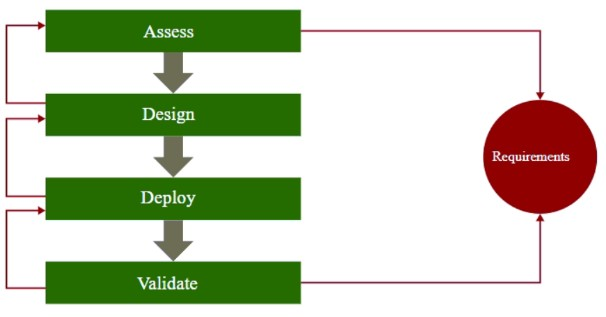
An architect is assigned a new project to design a VMware hybrid cloud solution.
The project is following a proven design methodology following the V-Model of systems
engineering and verification. The selected methodology follows these phases: Assess,
Design, Deploy and Validate.
Which activity would be conducted during the Design phase?
A. The architect conducts a series of group interviews with stakeholders
B. The architect helps stakeholders learn the mechanics of the solution
C. The architect resolves configuration issues and addresses concerns
D. The architect defines the scope of the project
Explanation
In the VMware Design Methodology (often represented via the V-Model), each phase has distinct objectives. The Design phase is where the conceptual, logical, and physical architectures are created based on the data gathered during the initial assessment.
Why B is correct:
A critical component of the Design phase is "Solution Socialization." During this stage, the architect presents the proposed design to stakeholders to ensure it meets their needs and that they understand the technical mechanics of how the solution will function. This helps achieve stakeholder buy-in and ensures that the design is technically sound before moving to the Deploy phase.
Why Other Options are Incorrect
A: Stakeholder Interviews:
This occurs during the Assess phase. This is the information-gathering stage where requirements, constraints, assumptions, and risks are identified.
C: Resolving Configuration Issues:
This occurs during the Deploy or Validate phases. Troubleshooting and fine-tuning the implementation are operational activities performed after the design has been finalized and installation has begun.
D: Defining Project Scope:
This is a primary output of the Assess phase. Scope must be defined and frozen before the Design phase can produce a finished architecture.
References:
VMware vSphere 8.x Advanced Design Guide: The VMware Design Methodology.
VMware VVD (VMware Validated Designs): Section on Design Methodology and Lifecycle.
An architect is tasked with designing a solution to monitor the operational state of a
VMware Cloud Foundation environment through ad-hoc reporting and custom dashboards,
alerts, and notifications.
Using VMware Validated Solutions, which validated solution can the architect leverage to
meet this requirement?
A. Private Cloud Automation for VMware Cloud Foundation
B. Intelligent Operations Management for VMware Cloud Foundation
C. VMware Validated Design for VMware Cloud Foundation
D. Heath Reporting and Monitoring for VMware Cloud Foundation
Explanation
The requirement is to monitor the operational state of a VMware Cloud Foundation environment through ad-hoc reporting, custom dashboards, alerts, and notifications. According to VMware Validated Solutions, the Health Reporting and Monitoring for VMware Cloud Foundation validated solution is specifically designed for this purpose.
D. Health Reporting and Monitoring for VMware Cloud Foundation
– Correct. This validated solution provides guidance on monitoring the operational state of your VMware Cloud Foundation environment through ad-hoc reporting or through custom dashboards, alerts, and notifications. It delivers health monitoring for VMware Cloud Foundation components using HTML reports, custom dashboards, alerts, and notifications.
Why other options are incorrect:
A. Private Cloud Automation for VMware Cloud Foundation
– Incorrect. This validated solution focuses on automating workload deployment and operations. It addresses automation use cases, not monitoring, dashboards, or alerting for operational state.
B. Intelligent Operations Management for VMware Cloud Foundation
– Incorrect. While this solution does provide monitoring capabilities for VMware Cloud Foundation components including dashboards and alerts, it is focused on full operations management including capacity planning and performance optimization. The search results show that Health Reporting and Monitoring is specifically described as providing "ad-hoc reporting and custom dashboards, alerts, and notifications" — a direct match to the customer requirement.
C. VMware Validated Design for VMware Cloud Foundation
– Incorrect. This is not a specific validated solution; it is the overarching reference architecture for deploying VMware Cloud Foundation. It does not specifically address custom dashboards, alerts, and notifications as described in the requirement.
Reference
VMware Health Reporting and Monitoring for VMware Cloud Foundation Documentation – "Provides guidance on monitoring the operational state of your VMware Cloud Foundation environment through ad-hoc reporting or through custom dashboards, alerts, and notifications"
Design Objectives for Health Reporting and Monitoring – "Provide health monitoring for VMware Cloud Foundation components by using HTML reports and through custom dashboards, alerts, and notifications"
An architect is designing a backup solution.
Which two statements should be included in the logical design for this solution? (Choose
two.)
A. The database must be backed up even/ day during the maintenance window of 1:00AM and 3:00AM.
B. The network that will be used for backups will be configured to use VLAN ID 1511.
C. The bkp-nfs-01 datastore will be used for backups.
D. The company's existing backup solution will be unsupported by the third-party vendor in six months.
E. The database will be backed up using an API-based backup solution.
Explanation
A logical design describes what the solution does at a conceptual level, without specifying physical details such as IP addresses, VLAN IDs, specific device names, or vendor product names. Logical design statements focus on policies, schedules, methods, and data flows.
A. The database must be backed up every day during the maintenance window of 1:00 AM and 3:00 AM – Correct.
This is a logical design statement because it defines a backup schedule and policy (frequency and time window) without specifying the physical mechanism, script name, or backup server.
E. The database will be backed up using an API-based backup solution – Correct.
This is a logical design statement because it defines the method or type of backup solution (API-based) without naming a specific vendor product (e.g., "Rubrik" or "Veeam") or physical configuration details.
Why other options are incorrect
B. The network that will be used for backups will be configured to use VLAN ID 1511 – Incorrect.
This is a physical or implementation design detail because it specifies an exact VLAN ID. Logical design would state
"a dedicated backup VLAN" without the numeric ID.
C. The bkp-nfs-01 datastore will be used for backups – Incorrect.
This is a physical design detail because it names a specific datastore object (bkp-nfs-01). Logical design would state "an NFS datastore will be used for backup storage" without the specific name.
D. The company's existing backup solution will be unsupported by the third-party vendor in six months – Incorrect.
This is a constraint or risk, not a logical design statement. It describes a future state of vendor support, not how the backup solution will be designed or function.
Reference
VMware Design Methodology (VCAP-DCV Design) – Logical design defines policies, schedules, methods, and data flows. Physical design specifies device names, IP addresses, VLAN IDs, and specific vendor products.
vSphere Backup Design Best Practices – Backup schedules, retention policies, and backup methods (agent‑based, image‑based, API‑based) belong in logical design. Specific datastore names and VLAN IDs belong in physical design.
An architect is responsible for the lifecycle management design for a brownfield vSpherebased
solution.
The following information has been provided during initial meetings around the new
solution:
Existing heterogeneous server hardware will be used to provide the hosting platform.
The available hardware is:
-- 10 servers that contain 2 x 20-Core Intel Xeon processors and 512 GB RAM from Vendor
A
-- 10 servers that contain 2 x 24-Core Intel Xeon processors and 768 GB RAM from Vendor
A
-- 20 servers that contain 2 x 16-Core AMD EPYC processors and 512 GB RAM from
Vendor B
-- 10 servers that contain 1 x 24-Core AMD EPYC processors and 256 GB RAM from
Vendor C
All of the hardware is currently listed on the VMware Hardware Compatibility List (HCL).
All existing server hardware has 36 months vendor support remaining.
The requirements from the customer are:
REQ001 - The solution must support the hosting of 5,000 workloads across two physical
sites.
REQ002 - The solution should minimize the number of clusters.
REQ003 - The solution must ensure that there is no impact to service when completing
upgrades.
Given the resource requirements needed for the solution, the architect has calculated that
all of the existing servers will be required to provide sufficient resources for the new
environment. The Intel-based servers will be deployed to the primary site and the AMDbased
servers will be
deployed to the secondary site.
Which four additional design decisions should the architect make to ensure all
requirements can be met? (Choose four.)
A. The solution will create an Intel-based 20-node vSphere cluster in the primary site and an AMD-based 30-node vSphere cluster in the secondary site.
B. The solution will use VMware SDDC Manager to perform lifecycle management of the solution.
C. The solution will ensure each vSphere cluster supports a minimum of N + 1 redundancy.
D. The solution will use vSphere Lifecycle Manager images to update and upgrade vSphere ESXi hosts in the secondary site.
E. The solution will use vSphere Lifecycle Manager baselines to perform patching and upgrading of vSphere ESXi hosts in the secondary site.
F. The solution will use vSphere Lifecycle Manager images to update and upgrade vSphere ESXi hosts in the primary site.
G. The solution will ensure each vSphere cluster is configured with Distributed Power Management (DPM).
Explanation:
The customer requires:
5,000 workloads across two physical sites
Minimize number of clusters
No impact to service when completing upgrades (requires cluster-level redundancy and lifecycle management)
All existing servers (20 Intel + 30 AMD) are needed
The architect has already decided: Intel servers to primary site, AMD servers to secondary site.
A. Create an Intel-based 20-node vSphere cluster in primary and AMD-based 30-node vSphere cluster in secondary
– Correct. This minimizes cluster count (two clusters total, one per site) and respects CPU vendor homogeneity within each cluster, which is required for vSphere HA, DRS, and vLCM image-based management. Mixing Intel and AMD in the same cluster is not supported for vLCM images.
C. Ensure each vSphere cluster supports a minimum of N+1 redundancy
– Correct. N+1 redundancy means the cluster can tolerate at least one host failure without impacting service. This directly supports REQ003 ("no impact to service when completing upgrades") because hosts can be placed in maintenance mode and upgraded one at a time while workloads run on remaining hosts.
D. Use vSphere Lifecycle Manager images to update/upgrade ESXi hosts in secondary site (AMD)
– Correct. vLCM images are recommended over baselines for simplified driver and firmware consistency, especially with heterogeneous hardware vendors. The secondary site uses AMD EPYC servers (Vendor B and C), which benefit from image-based management to ensure consistent software stacks across different AMD models.
F. Use vSphere Lifecycle Manager images to update/upgrade ESXi hosts in primary site (Intel)
– Correct. Same reasoning as above. Since primary site has two different Intel server models from Vendor A (20-core and 24-core), an image ensures consistent drivers and ESXi versions across both hardware types while remaining on the HCL.
Why other options are incorrect:
B. Use VMware SDDC Manager for lifecycle management
– Incorrect. SDDC Manager is specific to VMware Cloud Foundation (VCF) deployments. The question describes a standard vSphere brownfield environment with heterogeneous hardware, not a VCF-based solution. SDDC Manager cannot manage lifecycle for non-VCF vSphere environments.
E. Use vSphere Lifecycle Manager baselines in secondary site (AMD)
– Incorrect. While baselines could technically work, the question asks for design decisions to ensure all requirements can be met. Images (D and F) are superior because they manage drivers and firmware holistically, which is critical given the heterogeneous servers (Vendor B and C, different core counts). VMware recommends images over baselines for consistency and simplified lifecycle management in vSphere 8.x.
G. Configure Distributed Power Management (DPM)
– Incorrect. DPM powers off hosts during low demand to save energy. This could violate REQ003 ("no impact to service when completing upgrades") because DPM may power off hosts that would otherwise provide redundancy. Additionally, DPM adds complexity and potential latency when powering hosts back on, which is not required or beneficial for this design.
Reference
VMware vSphere Lifecycle Manager Documentation (vSphere 8.x) – vLCM images are recommended for clusters with heterogeneous hardware from the same CPU vendor to ensure driver/firmware consistency. Images support Intel and AMD clusters but cannot mix vendors in the same cluster.
VMware Design Best Practices – N+1 redundancy ensures zero-impact maintenance and upgrades. Minimum cluster size should be calculated based on failure tolerance, not DPM.
An architect is tasked with an application migration to a new VMware Cloud platform. The
application service owner assistance from the architect to identify the technical
requirements of the application.
The following has been made available following initial discussions:
A VMware Aria Operations report containing current resource usage
The output from a planning session including a roadmap for planned service growth
A service dependency map from the company’s IT operations management tool
The desired consolidation ratio for the target platform is 10:1
The applications hosting budget is reducing by 10%
Which two contain the technical requirements of the application? (Choose two.)
A. The output from a planning session including a roadmap for planned service growth
B. The desired consolidation ratio for the target platform is 10:1
C. A VMware Aria Operations report containing current resource usage
D. The applications hosting budget is reducing by 10%
E. A service dependency map from the company's IT operations management tool
Explanation:
Technical requirements describe the specific technical needs of the application to function correctly in the target environment — such as CPU, memory, storage, network, dependencies, and performance characteristics.
C. A VMware Aria Operations report containing current resource usage
– Correct. This report provides historical and real‑time technical metrics such as CPU utilization, memory consumption, disk IOPS, and network throughput. These are direct technical requirements for sizing the target platform.
E. A service dependency map from the company's IT operations management tool
– Correct. A dependency map identifies which services or components the application relies on (e.g., databases, authentication services, APIs). This is a technical requirement because it determines networking, firewall rules, startup ordering, and availability design.
Why other options are incorrect
A. The output from a planning session including a roadmap for planned service growth
– Incorrect. A growth roadmap is a capacity planning or business requirement, not a technical requirement of the application itself. It influences future scaling but does not define how the application works technically.
B. The desired consolidation ratio for the target platform is 10:1
– Incorrect. The consolidation ratio is a platform efficiency or cost target, often set by financial or operational stakeholders. It is not a technical requirement derived from the application; it is an imposed constraint on the environment.
D. The applications hosting budget is reducing by 10%
– Incorrect. This is a financial constraint or business requirement. It affects hardware selection, licensing, and possibly consolidation, but it does not describe the technical needs of the application.
Reference
VMware Design Methodology (VCAP-DCV Design) – Technical requirements are derived from application characteristics (resource usage, dependencies, performance metrics). Business requirements include budget, consolidation ratios, and growth roadmaps.
Application Migration Best Practices – Current resource usage (vCenter/Virtualization reports) and dependency maps are essential technical inputs; consolidation ratios and budgets are business constraints.
| Page 3 out of 12 Pages |
| 1234 |
| 3V0-21.23 Practice Test Home |