
Last Updated On : 12-Oct-2026
An administrator is tasked to create a development environment with a Tier-1 gateway to host overlay segments for only East/West workload communication. North/South communication is also required. The solution will not include the following services: NAT, DHCP, VPN. Which step must the administrator take when creating the Tier-1 gateway?
A. Configure a Service Interface on the Tier-1 gateway to connect each overlay segment to provide the East/West communication.
B. Enable route advertisement and connect the Tier-1 gateway to the Tier-0 gateway.
C. Assign the Tier-1 gateway to an Edge Cluster before any segments are created.
D. Keep route advertisement disabled and leave the Tier-1 gateway disconnected from any Tier-0 gateway.
Explanation|:
The requirement includes both East/West communication (between overlay segments) and North/South communication (to external networks). A Tier-1 gateway alone can handle East/West traffic between its connected overlay segments. However, to reach external networks (North/South), the Tier-1 must be connected to a Tier-0 gateway and must advertise its routes (connected segments and any learned routes) to the Tier-0. Without route advertisement, the Tier-0 has no knowledge of the Tier-1's segments, and return traffic from external networks cannot reach the workloads. Enabling route advertisement does not require NAT, DHCP, or VPN—those are optional and not needed here.
Why other options are incorrect:
A. Configure a Service Interface
– Service interfaces are for connecting to physical networks or services, not for connecting overlay segments. Overlay segments attach directly to the Tier-1 gateway via router ports, not service interfaces.
C. *Assign Tier-1 to an Edge Cluster before segments are created*
– Tier-1 gateways are assigned to an Edge Cluster only if they require stateful services (e.g., NAT, VPN, load balancing). This environment explicitly excludes those services, so the Tier-1 can run in edgeless mode (distributed routing only) without an Edge Cluster assignment.
D. *Keep route advertisement disabled and disconnected from Tier-0*
– This would isolate the Tier-1 completely, allowing East/West only but blocking all North/South communication, violating the requirement.
Reference
VMware NSX Documentation: *Tier-1 Gateways – Route Advertisement* – Route advertisement must be enabled and Tier-1 connected to Tier-0 for North/South traffic.
An administrator is upgrading an existing VMware Cloud Foundation (VCF) environment. An NSX Edge Cluster is required to support north-south traffic for a workload domain. How would the administrator initiate the edge cluster deployment?
A. From the VCF Installer.
B. Through VCF Operations Fleet Manager.
C. From vCenter Network Connectivity wizard.
D. From the vCenter Server Appliance Management Interface (VAMI).
Explanation:
In a VMware Cloud Foundation (VCF) architecture, the lifecycle management of the entire stack—including the automated deployment of NSX Edge Clusters—is centralized.
B. Through VCF Operations (SDDC Manager / Fleet Management):The SDDC Manager (now often referred to in broader operations contexts as part of the VCF Operations suite) is the primary engine used to automate the deployment of NSX Edge Clusters. The administrator initiates this process by navigating to the specific Workload Domain, selecting Add Edge Cluster, and providing the necessary parameters (such as TEP IPs, VLAN IDs, and BGP peering info). SDDC Manager then communicates with the underlying NSX Manager and vCenter to deploy the Edge VMs and configure the cluster automatically.
Why other options are incorrect:
A. From the VCF Installer:
The VCF Installer (Cloud Builder) is used exclusively for the initial bring-up of the Management Domain. It is not used for ongoing operational tasks like adding Edge Clusters to existing workload domains.
C. From vCenter Network Connectivity wizard: While vCenter manages the compute and storage of the Edge VMs, it does not have a native "VCF Edge Cluster" wizard that handles the specific integration, licensing, and management plane registration required by VCF.
D. From the vCenter Server Appliance Management Interface (VAMI):
The VAMI (port 5480) is used for appliance-level management, such as updates, backups, and network configuration of the vCenter Server itself. It has no role in deploying NSX networking components.
References
VMware Cloud Foundation Operations Guide: Deploying an NSX Edge Cluster in a Workload Domain.
VMware SDDC Manager Administration:Managing Networking and Security.
An administrator needs to prevent the datacenter from advertising any internal prefixes toward a new VPC, while still ensuring the VPC receives a default route learned from the datacenter's upstream network. Where should the routing policy be applied?
A. On each segment default gateway.
B. On the Tier-1 gateway.
C. On the VPC transit gateway.
D. On the provider Tier-0 neighbor.
Explanation:
In VMware Cloud Foundation (VCF) and NSX environments utilizing VPC-based architectures, the VPC Transit Gateway acts as the crucial demarcation point between the VPC's internal environment and the external (provider) network.
C. On the VPC transit gateway:
The VPC Transit Gateway is responsible for route aggregation and filtering between the VPC segments and the Tier-0 or Tier-1 provider gateways. By applying a routing policy (such as a Prefix List or Route Map) on the Transit Gateway, the administrator can explicitly filter out specific internal data center prefixes. At the same time, the policy can be configured to permit the default route ($0.0.0.0/0$) propagated from the upstream physical routers. This ensures the VPC remains isolated from internal network topology while maintaining internet or external connectivity.
Why other options are incorrect:
A. On each segment default gateway:
Applying policies at the segment level is highly inefficient and difficult to manage. Segment gateways handle local routing but are not the primary point for governing route advertisements to external entities or VPCs.
B. On the Tier-1 gateway:
While a Tier-1 gateway can perform NAT and routing, in a VPC model, the specific "Transit" logic and the boundary for VPC route leaking are handled by the Transit Gateway designed for that purpose.
D. On the provider Tier-0 neighbor:
Applying this on the Tier-0 neighbor (upstream physical router) would affect the entire SDDC, not just the specific VPC. The goal is to isolate the VPC, which requires a policy closer to the VPC's own entry point.
References
VMware Cloud Foundation 9.0 Networking Guide: VPC Networking and Transit Gateway Configuration.
NSX Administration Guide: Implementing Route Filtering and Prefix Lists.
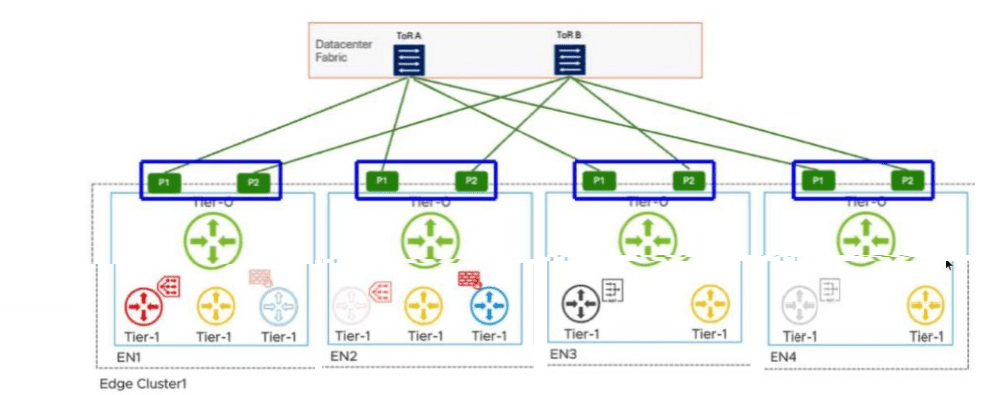
The network team has decided to use a single Edge Cluster to provide Tier-0 A/A Gateway
routing and Tier-1 Gateway A/S services.
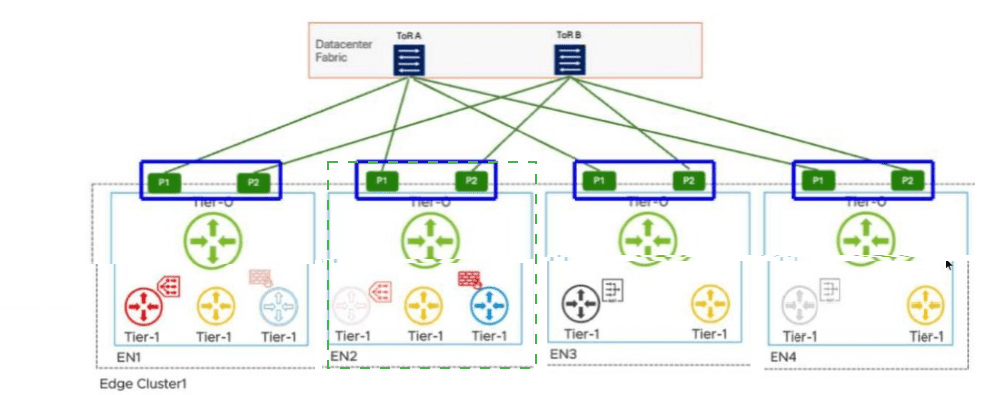
The active Tier-1 with a Gateway Firewall service is on EN2.
Which highlighted options will show the ECMP paths used by that Tier-1 GFW?
 Explanation:
In an NSX environment where a Tier-0 Gateway is in Active-Active (A/A) mode and a Tier-1 Gateway is in Active-Standby (A/S) mode with stateful services (like a Gateway Firewall), the traffic flow follows specific deterministic paths:
Stateful Service Constraints: When a Gateway Firewall is enabled on a Tier-1 gateway, it becomes a stateful entity. To maintain the integrity of the state table, all traffic for that Tier-1 gateway must process through the Active node for that specific Tier-1 instance.
Locality of Traffic: In the scenario provided, the Active Tier-1 gateway is hosted on EN2.
ECMP to the Tier-0: While the Tier-0 gateway itself uses ECMP (Equal-Cost Multi-Path) to reach the physical ToR (Top of Rack) switches (ToR A and ToR B), the Tier-1 gateway only leverages the paths available on the specific Edge Node where its Active instance resides.
Resultant Path: Therefore, the Tier-1 GFW on EN2 will use the specific uplinks (P1 and P2) connected to the Tier-0 instance running on EN2 to communicate with the physical fabric. It does not use the uplinks on EN1, EN3, or EN4, as doing so would require "punting" traffic across the fabric to a different node, breaking the stateful flow efficiency.
References
VMware NSX Design Guide: Section on Stateful Services and Edge Node Locality.
VMware Cloud Foundation 9.0 Networking: Tier-0 and Tier-1 Gateway Placement Strategies.
An administrator is responsible for managing a VMware Cloud Foundation (VCF) Private
Cloud consisting of a single VCF Fleet with a single Workload Domain.
The administrator has been tasked with configuring NSX to support the new Virtual
Desktop Infrastructure (VDI) solution that allows users to securely access a mainframebased
application located on the physical network. The VDI solution will use a dedicate
DHCP solution for each of the the desktop pool segments and static addresses for all
VDI management components.
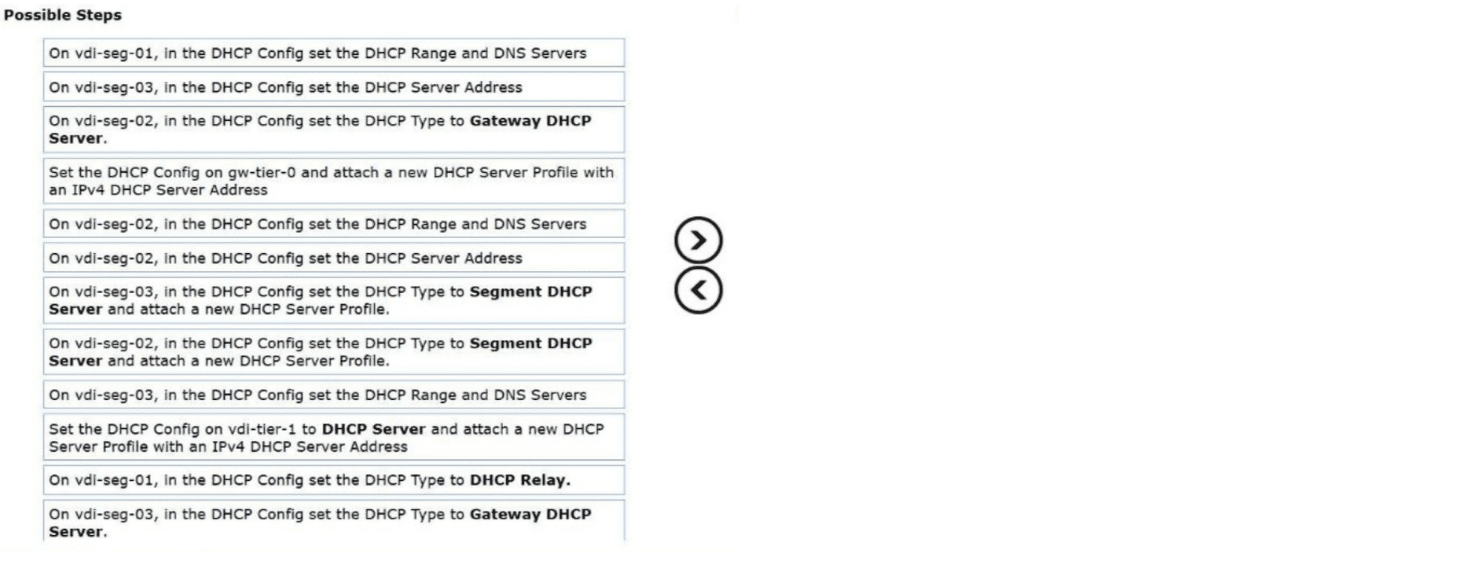
The administrator completes the following steps towards configuring DHCP:
1. Creates a new tier-1 gateway (vdi-tier-1) and links it to the tier-0 gateway (gw-tier-0).
2. Creates one new segment for vdi management (vdi-seg-01) and connects it to vdi-tier-1.
3. Creates two new segments for virtual desktops (vdi-seg-02 and vdi-seg-03) and
connects them to vdi-tier-1.
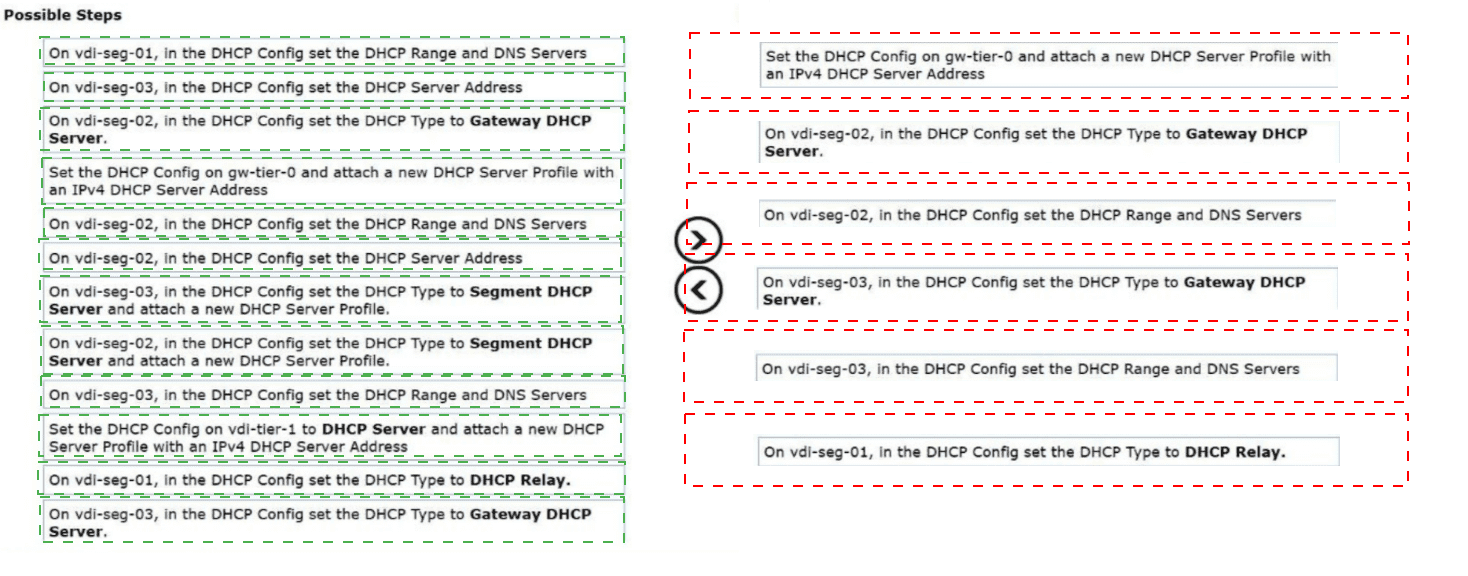
Drag and drop the six steps from the list of Possible Steps on the left and place them in
order in to the Solution Steps. (Choose six.)
Explanation:
The goal of this configuration is to provide a dedicated DHCP solution for the desktop pools while handling the management segment appropriately.
1. The Gateway DHCP Model
In this scenario, the administrator is using the Gateway DHCP model. This is established by first attaching a DHCP Server Profile to the Tier-0 gateway (gw-tier-0). This profile acts as the central management engine for DHCP services that will be consumed by downstream segments.
2. Segment Configuration (vdi-seg-02 and vdi-seg-03)
For the virtual desktop segments where dynamic addressing is required:
DHCP Type:By selecting Gateway DHCP Server, the segment leverages the profile already established on the Tier-0.
Scope Definition: The administrator must then define the specific DHCP Range (pool of addresses) and DNS Servers unique to each segment to ensure VDI clients receive the correct network configuration.
3. Management Segment (vdi-seg-01)
The scenario states that VDI management components use static addresses. However, to ensure flexibility or to allow for future communication with external DHCP resources (like the mainframe-based application environment), the administrator sets the type to DHCP Relay. This prevents the local NSX Gateway DHCP from interfering with the static nature of the management segment while allowing packet forwarding to an external DHCP server if necessary.
References
VMware NSX Administration Guide: Configuring DHCP on Segments and Gateways.
VMware Cloud Foundation 9.0 Networking: DHCP Design for VDI Workload Domains.
An administrator must provide North/South connectivity for a VPC. The fabric exposes a distributed external VLAN across all ESX hosts. But, the only BGP peer to the core is on a VLAN only accessible on the Edge Cluster. Which design is required?
A. Use a VPC Tier-0 Gateway in active/active mode with distributed eBGP peering.
B. Distributed Transit Gateway with an EVPN route reflector on the transport nodes.
C. Centralized Transit Gateway on the Edge Cluster.
D. Deploy a Provider Tier-1 with BGP and connect the VPC Transit Gateway via route leaking.
Explanation:
In a VMware Cloud Foundation (VCF) or NSX environment, the placement of the gateway determines how traffic enters and leaves the software-defined network.
Centralized Transit Gateway (C-TGW): When a Transit Gateway is "Centralized," it is instantiated specifically on an Edge Cluster. This design is mandatory when the physical network connectivity (such as BGP peering with the core) is only available on the physical uplinks connected to the Edge Nodes. By hosting the Transit Gateway on the Edge Cluster, the VPC can leverage the specialized networking paths (VLANs) and BGP sessions that do not exist on the standard ESXi compute hosts.
The Constraint: While a Distributed Transit Gateway (D-TGW) allows for optimized East/West traffic across all hosts, it cannot facilitate North/South BGP peering if those hosts lack access to the specific BGP peering VLAN. Therefore, the traffic must be "centralized" to the Edge Nodes where that peering is physically reachable.
Why other options are incorrect:
A. Use a VPC Tier-0 Gateway... with distributed eBGP peering:
Distributed eBGP peering would require every ESXi host in the fabric to have a direct BGP relationship with the core. The prompt explicitly states the BGP peer is only accessible on the Edge Cluster.
B. Distributed Transit Gateway with an EVPN route reflector:
EVPN is a high-level control plane architecture, but it doesn't solve the physical layer-2 reachability issue described. If the BGP VLAN is missing from compute hosts, a D-TGW cannot peer.
D. Deploy a Provider Tier-1 with BGP:
While Tier-1s can support BGP in specific newer NSX versions, the standard architectural solution for VPC isolation and external egress in this specific hardware-constrained scenario is the Centralized Transit Gateway.
References
VMware Cloud Foundation 9.0 Networking Guide: VPC Connectivity and Transit Gateway Placement.
VMware NSX Administration Guide: Centralized vs. Distributed Services.
During a design review, the administrator is asked to explain which underlying technology enables the NSX Edge to perform fast packet processing and achieve near line-rate performance for Virtual Network Functions (VNFs). Which technology is leveraged in the NSX Edge for fast packet processing?
A. Data Plane Development Kit (DPDK)
B. AMD Power Now
C. Non-Uniform Memory Access (NUMA)
D. Intel Speed Step
Explanation:
The Data Plane Development Kit (DPDK) is a set of libraries and drivers designed to accelerate packet processing by allowing the data plane to bypass the heavy overhead of the standard operating system kernel.
Why other options are incorrect:
AMD Power Now (B) and Intel Speed Step (D):
These are power management technologies that adjust CPU frequency to save energy. In high-performance networking, these are often disabled to prevent performance fluctuations.
Non-Uniform Memory Access (NUMA) (C):
While NSX Edge is NUMA-aware (meaning it tries to keep memory and CPU processing on the same local bus to reduce latency), NUMA itself is a memory architecture, not the specific packet-processing engine that enables line-rate speeds.
References
VMware NSX Administration Guide: NSX Edge Architecture and Data Plane Performance.
VMware Cloud Foundation 9.0 Design Guide: Edge Node Standard and High-Throughput Modes.
An administrator is preparing to deploy a new workload domain that will host vSphere Kubernetes Service (VKS) clusters. Before configuring the network for the Kubernetes clusters, the administrator needs to create a Tier-0 Gateway to handle North/South connectivity. What is the requirement for creating a Tier-0 Gateway for use with a workload domain that is running the vSphere Kubernetes service (VKS) with VPC?
A. The Tier-0 Gateway route map must contain an IP prefix with only a deny rule.
B. The Tier-0 Gateway must be configured in Non-Preemptive failover mode.
C. The Tier-0 Gateway must be configured in Active/Standby mode.
D. The Tier-0 Gateway must have IPv6 enabled.
Explanation:
When deploying vSphere Kubernetes Service (VKS) in a VPC-based architecture within VMware Cloud Foundation, the Tier-0 Gateway serves as the provider-level entry point.
Why other options are incorrect:
A. The Tier-0 Gateway route map must contain... only a deny rule:
This would block all traffic, preventing the Kubernetes clusters from communicating with the external network.
B. The Tier-0 Gateway must be configured in Non-Preemptive failover mode:
While preemptive vs. non-preemptive is a configuration choice, it is not a requirement for VKS/VPC functionality; the high-availability mode (A/S vs A/A) is the critical architectural requirement.
D. The Tier-0 Gateway must have IPv6 enabled:
While VCF 9.0 supports IPv6, it is not a mandatory requirement for the standard deployment of VKS clusters unless the specific environment is designed as IPv6-only or Dual-Stack.
References
VMware Cloud Foundation 9.0 Networking Guide: Networking Requirements for vSphere Kubernetes Service.
VMware NSX Administration Guide: Tier-0 Gateway Modes and Stateful Service Support.
| Page 2 out of 8 Pages |
| 123 |
| 3V0-25.25 Practice Test Home |